

CICU Chief Sees Major Export, Jobs Boost from Proposed India–EU Trade Pact
January 28, 2026
Ikramudin / Ludhiana
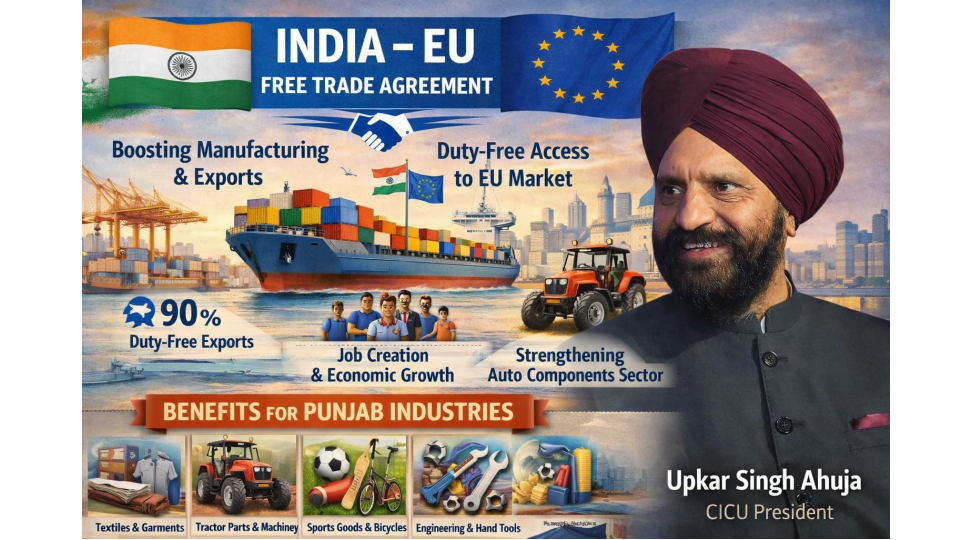
The proposed Free Trade Agreement (FTA) between India and the European Union is expected to significantly strengthen Indian manufacturing and exports, with nearly 90 per cent of Indian shipments likely to become duty-free, according to the Chamber of Industrial & Commercial Undertakings (CICU).
CICU President Upkar Singh Ahuja said the agreement would give Indian exporters a strong competitive edge, especially in labour-intensive sectors, as European countries face much higher labour and production costs. He pointed out that average labour costs in Europe stand at around 33 euros per hour, compared to less than ₹100 per hour in India, a gap that naturally favours Indian manufacturing without threatening domestic production.
Ahuja said the FTA would provide a major push to the services sector and labour-intensive exports, helping India expand its global footprint while generating large-scale employment. He added that agreements with high per capita income economies have historically benefitted Indian industry, and the India–EU pact is expected to follow the same trend.
The proposed agreement is also expected to bring substantial gains for Punjab’s manufacturing and export-oriented industries by easing access to European markets through reduced tariffs. Key sectors such as apparel, textiles, sports goods, knitwear, hosiery, and garments—particularly from Ludhiana—are likely to see improved competitiveness, leading to higher exports and job creation.
Punjab’s strong industrial base in tractor parts, farm equipment, auto components, engineering goods, hand tools, bicycles, sports goods, and food processing is also set to benefit from increased demand and new supply-chain opportunities. CICU said improved market access would help MSMEs invest in technology upgradation, enhance productivity, and achieve faster machine turnaround.
Highlighting sector-specific gains, Ahuja said auto components are expected to emerge as one of the biggest beneficiaries of the FTA. The European Union is already India’s largest export destination for auto components, accounting for nearly 30 per cent of total exports. India exported auto components worth USD 3.73 billion to Europe in the first half of FY26, recording an 11 per cent year-on-year growth.
He said the FTA would further improve export competitiveness, deepen technology collaboration with European manufacturers, and attract long-term investments into India’s auto component ecosystem. While public discussion may focus on potential reductions in luxury car prices, CICU stressed that the real impact of the agreement lies in manufacturing growth, export expansion, and stronger supply-chain integration.
CICU welcomed the proposed India–Europe FTA as a strategic move that would reinforce the Make in India initiative, strengthen India–EU trade relations, and position Punjab as a key contributor to India’s global manufacturing and export growth.
India Europe FTA CICU Punjab Industry Indian Exports Manufacturing Boost Auto Components Exports Ludhiana Textiles India EU Trade
Recommended Posts








Latest
The News Feed

Most Visited Stories


