

NITMA Hails India–EU Trade Pact as Game-Changer for Textile Exports
January 28, 2026
ETT News / Ludhiana
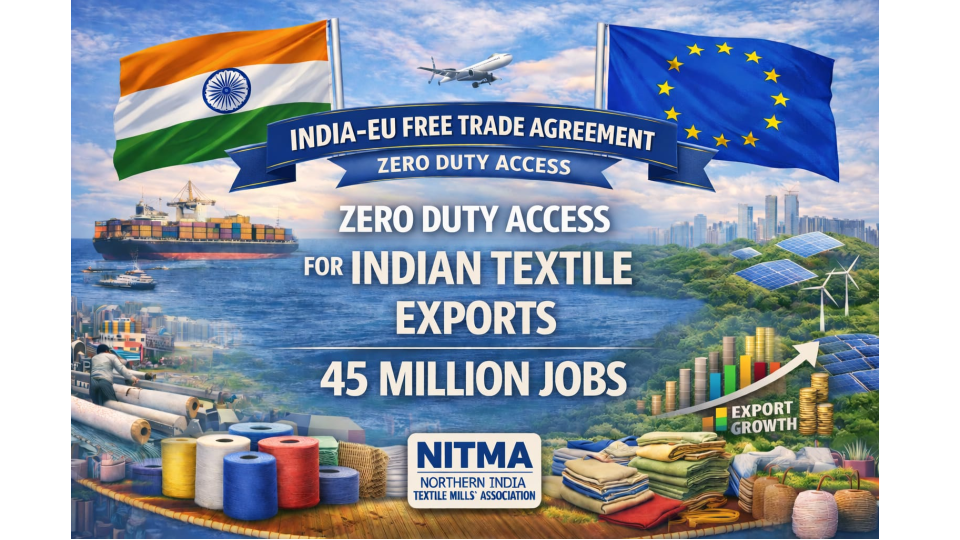
The Northern India Textile Mills’ Association (NITMA) officially welcomed the conclusion of the India–European Union Free Trade Agreement (FTA) today, hailing it as a transformative milestone that ends nearly two decades of negotiations. Announced at the 16th India-EU Summit, the landmark deal secures zero-duty access for Indian textile exports to the European market, effectively neutralizing a long-standing competitive disadvantage.
The association expressed profound gratitude to Prime Minister Narendra Modi, Commerce Minister Piyush Goyal, and Textiles Minister Giriraj Singh for securing a "balanced and fair" deal. Industry leaders noted that the agreement arrives at a critical juncture as global sourcing patterns shift and U.S. exports face increasing tariff pressures.
By eliminating import duties of up to 12%, the pact allows Indian exporters to compete on a level playing field with rivals such as Bangladesh, Pakistan, and Turkey. The European Union currently stands as India’s second-largest export destination, and with the EU's global textile imports valued at $263.5 billion, the FTA provides a massive growth trajectory for domestic manufacturers.
NITMA President Sidharth Khanna described the agreement as a "game-changer" for the entire value chain, noting that its success will hinge on the industry’s ability to innovate and meet stringent EU sustainability standards. The pact is expected to energize 342 textile clusters across India and support approximately 45 million livelihoods by boosting segments like garments, cotton, and man-made fibers.
Beyond immediate tariff removals, the agreement addresses non-tariff barriers through regulatory cooperation and customs facilitation. It also aims to drive foreign investment and technology transfer, particularly in "green manufacturing" and sustainable production processes aligned with European environmental norms.
However, the association also used the occasion to call for further domestic policy refinement, specifically regarding the India-ASEAN FTA. President Khanna highlighted a "critical duty anomaly" where raw polyester fiber faces a 5.5% duty while finished yarn enters duty-free, leading to a ten-fold surge in cheap imports that continues to disadvantage Indian mills.
The conclusion of the India–EU FTA, following recent pacts with the UK and New Zealand, solidifies India’s position as a premier global sourcing partner. NITMA officials stated that these strategic trade moves are essential steps toward a resilient and inclusive "Viksit Bharat" by strengthening the nation's manufacturing backbone.
India EU FTA NITMA Indian Textile Industry EU Market Access Zero Duty Exports Textile Trade
Recommended Posts


Latest
The News Feed

Most Visited Stories


